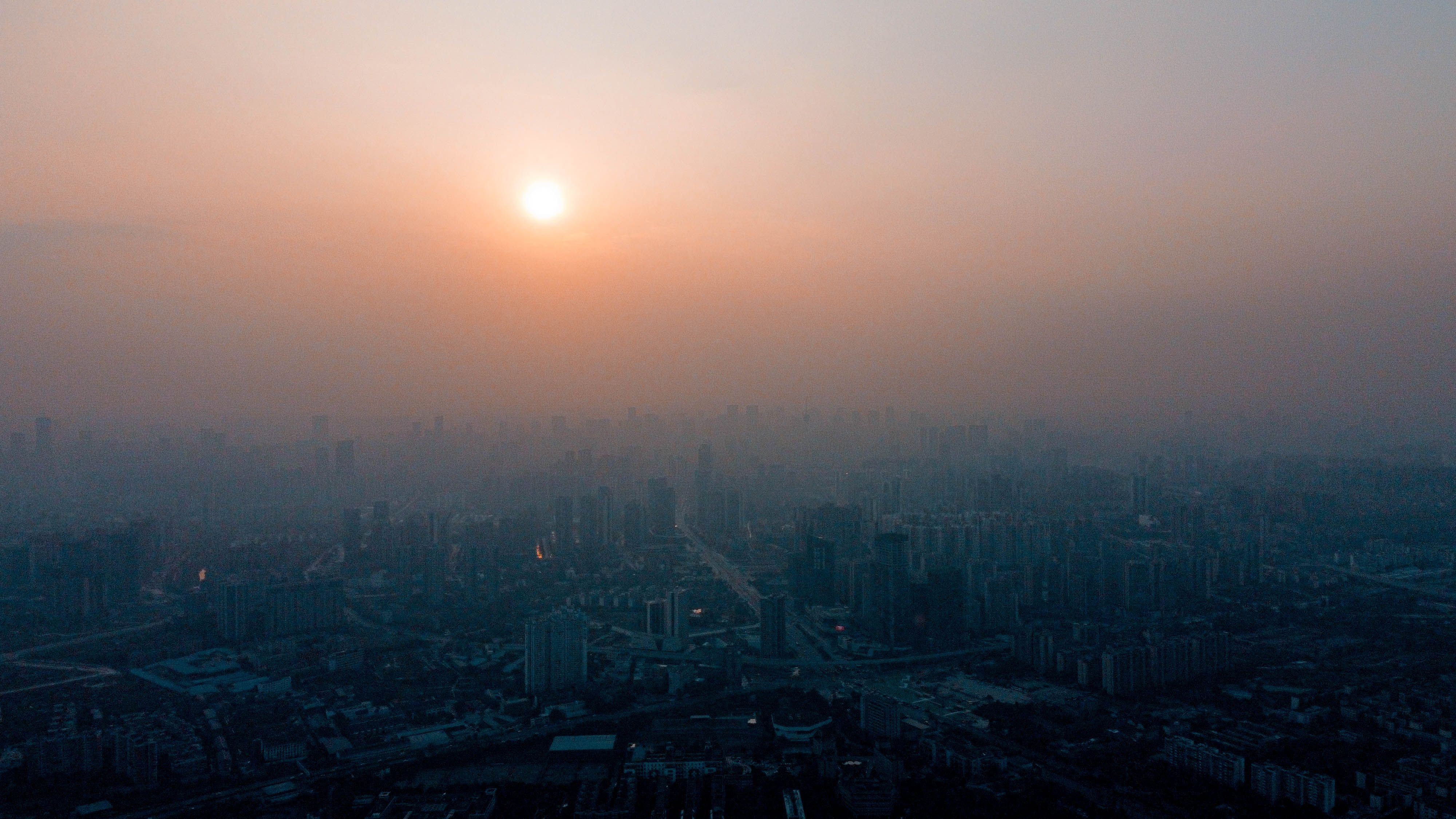
Photo: Pexels
On Monday morning, Lahore woke up to air so thick with pollution that the city's skyline had all but vanished. By 9am, the Swiss air-quality monitor IQAir ranked Lahore the most polluted major city on Earth, with an Air Quality Index of 590. An hourly reading on the same platform went further still: 647, deep inside the hazardous band. The second-most polluted city in the world that morning, Ulaanbaatar, recorded 177. Lahore's air was more than three times as dirty.
This was not a one-station blip. Across Punjab, the monitors told the same story. Raiwind recorded 688, Multan 655, Faisalabad 600. Inside Lahore itself, Allama Iqbal Town crossed 1,000. Fine particulate matter — PM2.5, the pollutant doctors worry about most — reached 357 micrograms per cubic metre in the morning. IQAir put that at 79.8 times the World Health Organization's annual guideline value.
By evening the wind shifted and the numbers eased — down to about 196 by 7pm, still unhealthy — but the day had already made its point. Lahore's smog season is back, earlier and harsher than many residents expected, and the argument over whose fault it is has started again before the air has even cleared.
What the numbers actually mean
The Air Quality Index runs from 0 to 500. Anything under 50 is considered good. Readings from 151 to 200 are unhealthy, 201 to 300 very unhealthy, and anything above 300 is hazardous — the level at which health warnings apply to everyone, not just children, the elderly and people with breathing problems. Lahore spent much of Monday above 600, a figure the scale was barely designed to describe.
The gap with the rest of the world was striking. Delhi, which usually trades places with Lahore at the top of these rankings, sat at 174 on Monday morning. Kolkata recorded 173, Sarajevo 170. Lahore was not edging ahead of its rivals; it was in a category of its own.
It is worth noting that the numbers move through the day. Punjab Senior Minister Marriyum Aurangzeb said later on Monday that the reading had dropped to 208, and IQAir showed 196 by the evening. That is the pattern of a smog episode driven partly by weather: cold, still air traps pollution close to the ground overnight and in the early morning, and a change in wind can clear it almost as fast. The problem is that the relief is temporary. The Punjab government itself forecast that pollution would stay high through Tuesday, November 10, with only a slight improvement expected from Wednesday.
The first week of November already set the tone. According to an assessment by the Pakistan Air Quality Initiative, reported on November 9, Lahore averaged an AQI of 268 across the first week of the month, with hazardous levels on two of those days. The crisis did not arrive out of nowhere; it has been building since the start of the month.
Why Lahore gets smog every winter
Lahore's smog is not a mystery, and it is not a single cause. It is the same mix, in roughly the same order, every year — which is part of what makes the annual recurrence so frustrating for the people breathing it.
First, the geography works against the city. Lahore sits on a flat plain, and in winter the temperature drops enough at night for a layer of cold air to settle near the ground, trapping warmer air — and everything in it — above it. This temperature inversion acts like a lid. Exhaust fumes, factory smoke, dust from construction and smoke from burning crop residue all pile up underneath it instead of dispersing.
Second, the sources are local and large. Millions of vehicles, many of them old and poorly maintained, burn fuel on congested roads. Brick kilns ring the city. Industry, construction dust and open burning add more. Then there is the seasonal ingredient: farmers across Punjab burn rice stubble after the harvest, and the smoke drifts across the province. The provincial environment department recorded 459 crop-fire reports between October 1 and November 4, and registered 57 police cases for crop burning — down 28 per cent on the same period last year, which shows enforcement is happening, but also shows how much burning still goes on.
Third, the pollution does not respect the border. Smoke from the Indian side of Punjab, including from Diwali fireworks, drifts westward on the prevailing winds. That cross-border contribution is real, but its exact size is genuinely hard to pin down — and that uncertainty is where the politics begins.
The Diwali argument: what is known and what is not
On Monday, Marriyum Aurangzeb linked the spike partly to large-scale fireworks during Diwali celebrations in India, saying polluted winds entering through the eastern corridor had added to the problem. A special report issued by the provincial government on November 8 had predicted that smoke from Diwali fireworks could reach Lahore within five to 13 hours.
The claim is plausible. Diwali fell just before the spike, fireworks produce enormous bursts of particulate matter in a short time, and the wind direction fit. But plausibility is not measurement. As Geo News reported, the precise share of Lahore's pollution attributable to cross-border sources has not yet been independently established. That is an important distinction, and it is one that tends to get lost when a smog episode becomes a political argument.
The Punjab Environment Protection Department is expected to release comparative findings on November 10, assessing how much each source — weather, local emissions, farm fires and cross-border pollution — contributed to this episode. Whatever that report says, it will matter. If it shows the cross-border share was small, the government will have to answer harder questions about its own sources. If it shows the share was large, it strengthens the case for the kind of cross-border cooperation that, so far, has barely existed.
The same fossil-fuel combustion that fills Lahore's air is also the force behind the wider energy shock of recent weeks — oil prices have climbed past $110 a barrel this autumn, driven by the same regional tensions. Smog and energy prices are usually reported as separate stories. In Lahore this week, they are two symptoms of the same dependence.
What breathing this air does to you
PM2.5 is the number to watch because of its size. These particles are less than 2.5 micrometres across — about thirty times finer than a human hair — small enough to pass deep into the lungs and from there into the bloodstream. That is why health agencies treat PM2.5 as the most dangerous common pollutant: it is linked to asthma attacks, bronchitis, heart disease, strokes and reduced lung function, and children, pregnant women, the elderly and people with existing heart or lung conditions are hit hardest.
The World Health Organization estimates that air pollution contributes to around 7 million premature deaths worldwide every year. Lahore's contribution to that figure is not abstract. On days like Monday, hospitals see more patients with coughing, wheezing, burning eyes and sore throats. A Daily Pakistan report on the crisis put the exposure in stark terms, comparing a day of breathing Lahore's air at these levels to smoking 24 to 33 cigarettes. The comparison is rough, but it captures something real: at an AQI above 600, simply being outside is a health decision.
The damage is not only measured in hospital visits. Smog closes the gap between the rich and the poor in the cruellest way: those who can afford air purifiers, sealed homes and cars with filtered air can buy their way out of some of the exposure. Daily-wage workers, rickshaw drivers, street vendors and schoolchildren on bicycles cannot. Photographs from Monday showed a child in school uniform and a mask riding a bicycle through the haze — an image that says more about the crisis than any AQI chart.
What the government is doing — and why it is not enough
The Punjab government is not standing still. It has a smog plan, anti-smog operations, fines for crop burning and vehicle emissions checks, and it has been spending heavily on climate and environmental programmes. A Daily Pakistan segment noted the province allocated 123 billion rupees for climate resilience and environmental sustainability in 2025–26 and 479 billion rupees for 2026–27. Those are large numbers, and they invite an obvious question: if the money is being spent, why is the air still the worst in the world?
Part of the answer is time. Air quality does not respond to budgets the way a road or a building does; the sources are diffuse, the enforcement is hard, and the payoff from cleaner vehicles, kilns and farming practices takes years. Part of the answer is that smog is a regional problem being fought with provincial tools. Punjab can fine its own farmers and shut its own kilns, but it cannot control what blows in from across the border, and it cannot change the winter weather.
But part of the answer is also political will. Smog arrives every year on roughly the same schedule, and every year the response follows the same pattern: emergency measures during the worst days, blame directed outward, and attention drifting away as soon as the wind changes. The criticism is not new — it was the same last year, and the year before. The province's politics are turbulent at the best of times; the recent emergency rule in Khyber Pakhtunkhwa is a reminder of how quickly governance crises can crowd out slower-burning ones like air quality. Smog, unlike a political crisis, does not make for dramatic television — it just quietly fills lungs, day after day.
What happens next
In the short term, the forecast offers limited comfort. The Punjab government expects pollution to stay high through Tuesday, with some improvement from Wednesday as weather conditions change. IQAir's forecast puts Lahore's daily average at about 164 on Tuesday and 163 on Wednesday — still rated unhealthy, but a long way down from 647. The Environment Protection Department's comparative findings, due on Tuesday, should give the first solid answer to the question everyone is asking: how much of this came from across the border, and how much was homegrown?
In the longer term, the pattern is what should worry Lahore's residents most. The city has now topped the world's pollution rankings repeatedly in recent winters, and each year the episode seems to arrive with the same ingredients and the same arguments. South Asia's climate extremes are stacking up — from the Himalayan flood disaster that killed more than 750 people in October to Lahore's choking air this week — and the region's cities are absorbing the consequences faster than their governments are adapting.
The fixes are known, and none of them is exotic: cleaner public transport so people are not forced into old cars and motorbikes, zigzag technology for brick kilns, real alternatives to crop burning that farmers can actually afford, year-round enforcement instead of emergency measures, and — hardest of all — a working arrangement with India on the shared airshed, because the wind does not carry a passport. What is missing is not knowledge. It is the sustained, unglamorous work of applying it between crises, when nobody is watching the AQI.
Three things this episode reveals
The first is the gap between measurement and action. Lahore now has monitors, rankings, forecasts and comparative studies. The city knows, hour by hour, exactly how bad its air is. What it does not yet have is a response that matches the precision of the measurement. Knowing the AQI hit 647 is not the same as stopping the next 647.
The second is how quickly a public-health crisis becomes a blame game. The Diwali argument may turn out to be partly right — the wind direction and timing fit — but the speed with which it was offered, before any comparative data existed, suggests it serves a political purpose as well as an explanatory one. Every unit of pollution blamed on the other side of the border is a unit the government does not have to account for at home. The Environment Protection Department's report, due today, is the test of whether the claim survives contact with evidence.
The third is that smog is a regional problem wearing a local face. Lahore's air is made in Lahore, in the fields around it, and across the border — all three at once. No single government can fix it alone, and no single season's emergency measures will fix it at all. Until the countries and provinces that share this airshed treat it as a shared problem, Lahore will keep topping a ranking no city wants to lead, and its residents will keep paying for it with their lungs.
Frequently asked questions
What is AQI and what does 647 mean?
AQI, the Air Quality Index, is a scale from 0 to 500 that converts pollutant concentrations into a single number. Readings under 50 are good, 151–200 are unhealthy, 201–300 very unhealthy, and anything above 300 is hazardous. At 647, Lahore's air was more than twice the threshold for the worst category, a level at which health warnings apply to the entire population.
Why is Lahore's air so bad in winter?
Cold winter nights create temperature inversions that trap pollution close to the ground, while the sources — vehicle exhaust, brick kilns, industry, construction dust and crop burning — keep producing it. Calm winds and low rainfall in winter mean the pollution is not dispersed or washed away, so it accumulates day after day.
How much of Lahore's smog comes from India?
Nobody can say precisely yet. The Punjab government blames Diwali fireworks and cross-border smoke in part, and the wind direction on November 9 was consistent with that. But the exact share has not been independently established, and the Punjab Environment Protection Department's comparative findings, due November 10, are meant to answer that question with data rather than assertion.
Is it safe to go outside when the AQI is above 600?
Health agencies advise avoiding outdoor exertion at hazardous levels, especially for children, the elderly and people with asthma or heart conditions. If you must go out, a well-fitted N95 mask helps against PM2.5, though it is no substitute for staying indoors. Keep windows closed, run an air purifier if you have one, and watch for symptoms like wheezing, chest tightness or burning eyes.
Does smog really compare to smoking cigarettes?
It is a rough comparison, not a precise one. Researchers sometimes convert PM2.5 exposure into a cigarette equivalent to make the risk intuitive — a Daily Pakistan report on this episode put a day of Lahore's air at 24 to 33 cigarettes. The exact number depends on the conversion used, but the underlying point is sound: at these concentrations, breathing the air carries a serious, measurable health cost.
When will Lahore's air improve?
The short-term forecast points to some improvement from Wednesday, November 11, as weather conditions change, with daily averages forecast around 163–164 — still unhealthy, but far below Monday's peak. A lasting improvement, though, depends on year-round action on vehicles, kilns, crop burning and cross-border cooperation, not on a change in the wind.
Sources
- Dawn — "Lahore remains world's most polluted major city as AQI crosses 600" (Nov 9, 2026): dawn.com/news/2043255
- Dawn — "Lahore continues to be most polluted city while govt looks 'the other way'" (Nov 10, 2026): dawn.com/news/2043398
- Geo News — "Punjab links smog to cross-border Diwali fireworks in India as Lahore's AQI tops 600" (Nov 9, 2026): geo.tv
- The Thursday Times — "Lahore AQI today: world's most polluted city at 590, hourly reading 647" (Nov 9, 2026): thursdaytimes.com
- Daily Pakistan — "Lahore emerges as world's most polluted city as AQI reaches 600" (Nov 9, 2026): en.dailypakistan.com.pk
- PakWheels Blog — "Lahore Air Quality Turns Hazardous as AQI Tops 600" (Nov 9, 2026): pakwheels.com
- Dawn Today (Instagram) — Lahore AQI report, Nov 9, 2026: instagram.com/p/DfhB-XglZIu/
- IQAir live global city rankings, as cited by Dawn and Geo News, Nov 9, 2026