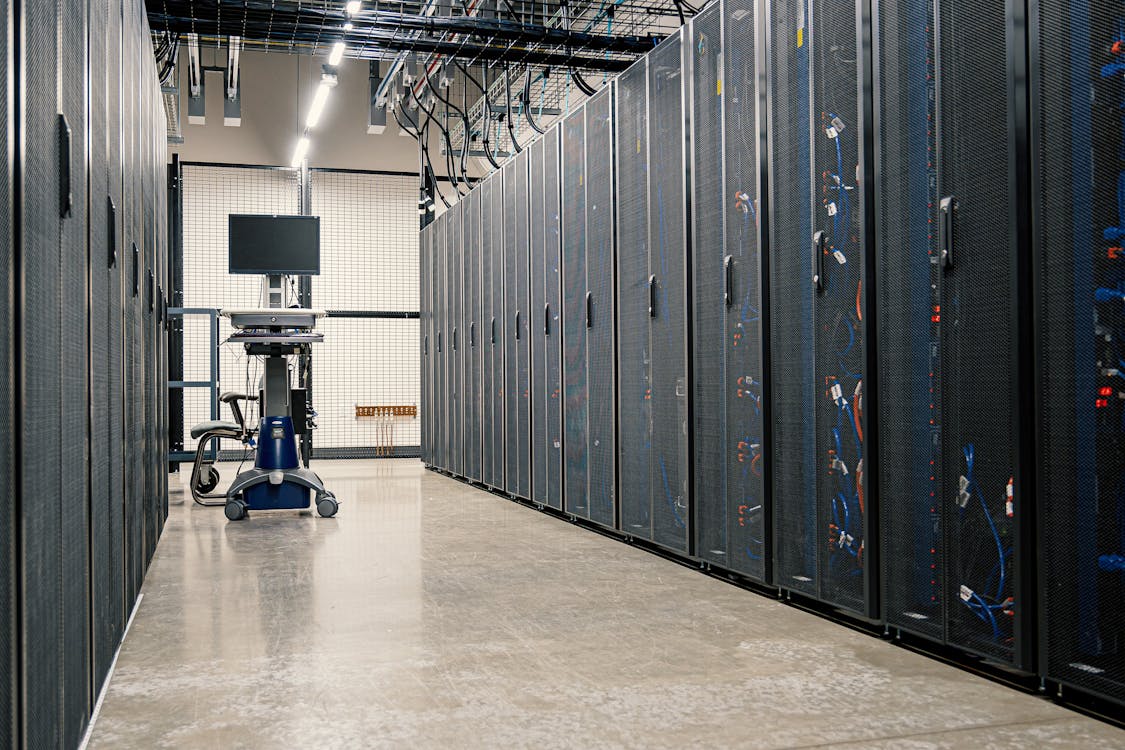
Rows of server racks in a modern data center — the physical backbone of every AI model. (Photo: Pexels)
OpenAI is trying to raise $30 billion at a valuation of more than $1.4 trillion. Thirty billion exceeds the GDP of roughly 120 countries — and this company raised $122 billion in March, seven months ago.
So why does the maker of ChatGPT need another $30 billion — and why rush to lock in commitments before rival Anthropic lists in mid-November? The answer runs deeper than one funding round. It explains why AI costs the staggering amounts it does, who is really footing the bill, and what the next two years of the AI era will look like.
What actually happened
OpenAI is seeking approximately $30 billion in fresh funding at a potential valuation exceeding $1.4 trillion, Reuters reported on October 19, citing two people familiar with the matter. The company wants to move unusually fast — because it wants commitments secured before Anthropic's expected mid-November stock market debut. SoftBank Group, Abu Dhabi-based MGX, and other existing backers are in talks to join, and OpenAI met long-only funds and sovereign wealth funds last week — the same week Anthropic hosted its own investor day.
Bloomberg reported on October 5 that several UAE funds, including MGX, are discussing a collective contribution of up to $10 billion to anchor the round, alongside BlackRock. OpenAI is presenting the $1.4 trillion valuation as a fixed pre-money price — no lead investor negotiating it, a sharp departure from how venture rounds normally work. Thrive Capital, Andreessen Horowitz, and the UC endowment have also held talks about participating.
For context: OpenAI's March 2026 raise was $122 billion at an $852 billion valuation — so this round would price the company about 64% higher, seven months later. Its annualized revenue run rate sits between $50 billion and $70 billion, per recent reports. And its IPO has been pushed back to 2027 at the earliest.
Why the rush? Beating Anthropic to the same money
Timing is the entire story. Anthropic — the company behind Claude — is expected to go public in mid-November in what could be one of the largest IPOs in history. Once it is public, its financials become visible to everyone, and every investor in OpenAI's private round would compare the two companies line by line. OpenAI would clearly prefer to set its $1.4 trillion price tag before that comparison exists.
Both labs are fishing in the same small pond — sovereign wealth funds, long-only funds, the Gulf states, a handful of asset managers. That pond has deep pockets, but it is not infinite; whoever gets firm commitments first locks up capital the other cannot use.
And Anthropic is not standing still. In mid-October it announced plans to list as a public benefit corporation, committed 5% of its equity to a public benefit fund, and is arranging roughly $60 billion in debt to buy chips. Both labs are sprinting for the same pool of capital.
Where $30 billion actually goes
To understand why an already-giant company needs another $30 billion, you have to understand what frontier AI physically is. It is not an app. It is an industrial operation.
Start with computing power. In 2025, OpenAI announced plans for 26 gigawatts of computing capacity with Nvidia, AMD, and Broadcom — one gigawatt powers roughly 750,000 homes, so 26 gigawatts is the electricity use of a mid-sized country. Nvidia, which put $30 billion into OpenAI's March round, signed a letter of intent for at least 10 gigawatts of its systems (with a plan to invest up to $100 billion as each gigawatt is deployed) and in August agreed to guarantee up to $105 billion of obligations at an Ohio data center campus under 20-year leases to OpenAI.
Training a frontier model is enormously expensive, but inference — answering hundreds of millions of daily queries — is the bigger ongoing bill once a model is popular. Every prompt carries a real electricity and hardware cost. Add the scarcest ingredient — elite researchers paid like star athletes — plus land, power contracts, and cooling. Moody's estimates global AI infrastructure spending is approaching $1 trillion a year. In that context, $30 billion is not a war chest. It is a down payment.
Anthropic's counter-play: debt, the IPO, and a very unusual fund
Anthropic's strategy looks different. Instead of one giant private round, it is going public — expected mid-November — as a public benefit corporation, a corporate form that legally allows it to weigh its mission alongside shareholder returns. Its third-quarter revenue stood at $16.8 billion, per CNBC, and its May Series H valued it at $965 billion, with reports putting its IPO target around $2 trillion.
On October 18, Anthropic announced it would commit 5% of its shares to a new Public Benefit Fund — with the board able to add another 2% for every 50% rise in the company's value above a set baseline, subject to stockholder approval. Combined with an earlier founder pledge to donate 80% of personal equity and an employee donation-matching program about half the staff joined, Anthropic says roughly 20% of its shares will be dedicated to public benefit. The named first use case: AI's impact on jobs. The fund will be an LLC, not a charity, and none of it may go to lobbying or political donations.
At the same time, Anthropic is arranging roughly $60 billion in debt to finance chip purchases — with portions reportedly priced at yields above 10%. That is expensive money. It tells you how much these companies value speed: they would rather pay double-digit interest than wait.
The uncomfortable arithmetic
Here is the part nobody in the press releases will say out loud.
OpenAI's annualized revenue is somewhere between $50 billion and $70 billion. Its infrastructure commitments — data centers, chip deals, power contracts — run into the hundreds of billions. That gap is the entire bet of this era of AI: revenue must keep roughly doubling for the math to work.
The valuation mechanics of this round are revealing. OpenAI is not negotiating its $1.4 trillion price with a lead investor. It is declaring it. In March, the market priced the company at $852 billion. Seven months later, the price is up 64% — set by the company itself. No company's fundamentals grow 64% in seven months without some storytelling doing part of the lifting.
This is not to say the revenue isn't real. Going from a few billion to a $50–70 billion run rate in a couple of years is extraordinary. But the fundraising is not funding today's business. It is funding a 26-gigawatt vision of 2029 and a 20-year Ohio campus — a bet that the revenue curve keeps bending upward faster than the interest bills bend downward.
Three things this tells us about the next two years
First, compute is the new oil. Whoever controls graphics processors and electricity contracts sets the pace — every major deal here is really a chip deal wearing a finance costume.
Second, Anthropic's IPO will price AI for the first time in public. Whatever Anthropic's shares do in their first weeks will become the reference point for every AI valuation on earth — including OpenAI's planned 2027 listing. That is precisely why OpenAI is rushing: it wants its $1.4 trillion locked in before the market gets a vote.
Third, watch the debt. If revenue growth stumbles, the pain arrives through financial channels before it arrives through technology. AI companies don't fail by building worse models. They fail by being unable to finance the models they already promised.
What it means for the rest of us
You don't need to be an investor for this to matter. The costs will, eventually, show up in prices. Running models gets cheaper per query every year, but total usage grows faster — so pressure on subscriptions, API pricing, and enterprise contracts points upward. Watch enterprise AI contracts first; consumer prices follow.
For startups, the message is to build on someone else's infrastructure rather than your own — the capital bar for training frontier models is now in the tens of billions, for all but a handful of companies. And for workers: Anthropic's benefit fund has named AI's impact on jobs as its first priority. The industry itself is setting aside billions against the possibility that its own products displace large numbers of workers. Worth taking seriously, whatever your opinion of the technology.
Frequently asked questions
Why does OpenAI need $30 billion if it's making $50–70 billion a year?
Revenue and spending commitments live on different timelines. Revenue arrives quarter by quarter; the commitments — multi-gigawatt data centers, 20-year campus leases, chip supply deals — demand cash now. The $30 billion bridges that gap and cushions the balance sheet if IPO markets stay cold through 2027.
Is the AI industry in a bubble?
Parts of it are priced on projections, not cash flow — a $1.4 trillion valuation set by the company itself, with no negotiating lead investor, is not how sober markets usually work. But AI's underlying revenue growth is genuinely extraordinary. The technology is real; some prices just assume it stays miraculous forever.
What happens if Anthropic's IPO goes badly?
Investors would immediately re-price OpenAI's $1.4 trillion ask downward, and its 2027 listing plans would get harder. Anthropic's $60 billion of chip debt — some at yields above 10% — would also get more expensive to refinance. The first pain would land on lenders and late investors, not on users.
What is a public benefit corporation, and why is Anthropic listing as one?
It is a corporate form that legally permits a company to pursue a stated public mission alongside shareholder returns, with reporting to back it up. For Anthropic, it signals that its safety mission survives the IPO — which matters when your product is under scrutiny from governments on several continents.
Will ChatGPT get more expensive?
Upward pressure exists — inference at global scale is costly — but per-query costs keep falling as hardware improves. Watch enterprise pricing first; consumer subscriptions follow a year or two later.
The bottom line
$30 billion, raised in a hurry, at a self-declared $1.4 trillion valuation, weeks before a rival's blockbuster IPO. Strip away the theater and you have the clearest statement yet of what frontier AI has become: an industry where the product is intelligence, the raw material is electricity and silicon, and the bill keeps arriving faster than the revenue.
The next chapter gets written in mid-November, when Anthropic goes public and the market finally prices this industry in the open. Whatever happens that week will echo through every AI company — including the one raising $30 billion right now.
For more technology explainers and AI analysis, visit abdulrahimmughal.com.